
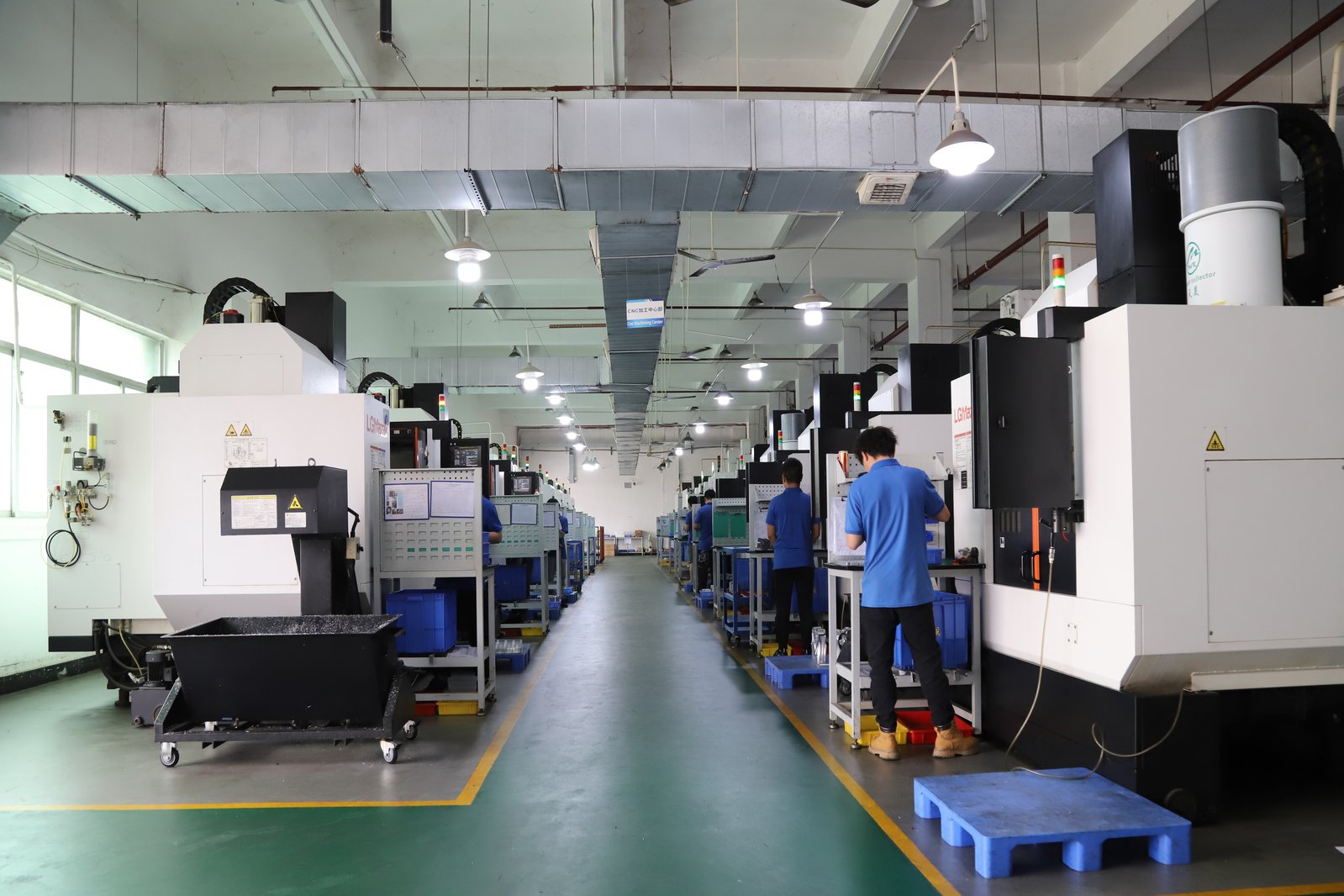
- 6,800 m² across two buildings in Hengli Town, Dongguan, production, inspection, and engineering under one roof.
- ISO 9001:2015 / IATF 16949:2016 / ISO 14001:2015, certificate numbers published and verifiable.
- 5 Axis Machining: Impellers, blisks, turbine components, orthopaedic implants, complex housings, and any part where several faces must hold a geometric relationship tighter than a fixture can repeat.
- Where it stops: Five-axis programming and verification cost real time.
- Prototype and production run on the same floor and the same process.
What 5 axis machining changes about the process
5 axis machining is three linear axes plus two rotary axes, so the tool can approach the workpiece from any direction in a single clamping.
The gain is not the extra axes themselves, it is the ability to keep the tool short and keep the cutting contact consistent. Tilting the tool to maintain a constant contact angle lets a shorter, stiffer cutter be used, and a shorter cutter deflects less, which is what actually holds a tolerance on a deep wall.
Which geometries justify 5 axis machining?
Impellers, blisks, turbine components, orthopaedic implants, complex housings, and any part where several faces must hold a geometric relationship tighter than a fixture can repeat.
Highest hourly rate, but often the lowest total cost on a complex part, because the setup count, the fixture count, and the scrap risk all fall together.
Where does 5 axis machining stop paying?
Five-axis programming and verification cost real time. On a part that three axes can reach, the extra capability buys nothing and costs lead time.
This boundary is stated deliberately. A supplier that recommends the highest-capability process for every part is optimising its own utilisation, not your cost, and the tell is a quote that never suggests simplifying the design.
How is the toolpath verified before it touches material?
Every programme is simulated offline before it reaches a machine: tool and holder collision, axis limits, and material removal against the stock model. On five-axis and mill-turn work this is not optional — the number of possible collision cases grows with each rotary axis, and a crash on a part that has already absorbed eight hours of cycle time is the expensive kind.
The verification step belongs in the quote. It is real engineering time, and a supplier that omits it is either simulating badly or not simulating at all.
Three questions that test the claim
Ask for a part the supplier has actually made on five axes, and ask how many machines in the family were running it. A plant with one five-axis machine can show you a part; the question is what happens to your delivery when that machine is down. Ask also whether the five-axis motion is simultaneous or positional — the two are priced the same and are not the same capability.
None of these questions are hostile and all of them are cheap. A plant with the capability answers them easily; a brochure cannot.
What design decisions move the cost on micro CNC machining?
The two design decisions that dominate five-axis cost are cavity depth relative to tool diameter and internal corner radius. A corner specified at 1 mm forces a 2 mm cutter through the whole pocket, which sets the stepover and therefore the cycle time; opening it to 3 mm or 4 mm often halves the machining time. Deep, narrow cavities have the same effect through tool deflection.
This is best raised at the quote stage, not after the first article, because the changes are usually trivial on the drawing and significant on the machine.
What tolerance applies?
±0.003 mm on CNC milling, ±0.002 mm on CNC turning; ±0.002 mm where precision grinding or wire EDM is used, fixed for each feature at the quote.
Which entity is responsible for the work?
Dongguan Zhuohang Ltd (Registration No. 91441900MA4UWT6X39, established 2005).
Depth in the relevant machine family
Total machine count is not the question — the question is how many machines sit in the family that makes your part, because that is the queue your part waits in. The floor runs over a hundred machines: 50+ three-axis centres for prismatic work, 20+ four-axis, 20+ five-axis, 25+ turning and mill-turn centres, Swiss-type lathes for long slender parts, precision grinding and wire EDM for the tightest features.
Depth in the same family is what lets a part send work to a free machine instead of letting it wait when a machine is pulled for service. That, not the headline machine, is what protects a delivery date.
What do the certificates actually cover?
Three certificates, each with a number you can check with the registrar:
| Standard | Certificate number | Scope note |
|---|---|---|
| ISO 9001:2015 | 116024/A/0001/UK/En | Quality management system |
| IATF 16949:2016 | 131941/A/0001/SM/En | Automotive QMS — excludes clause 8.3 product design |
| ISO 14001:2015 | 116024/B/0001/UK/En | Environmental management system |
The IATF 16949 certificate excludes clause 8.3 (product design). That is normal for a build-to-print manufacturer and it is stated here rather than left for an auditor to discover: we manufacture against your design, it does not originate the design.
What the extra axes actually buy
The axis count is about setups, not precision. A 3-axis machine cuts from one direction, so a part with features on several faces needs to be re-fixtured between operations - and every re-fixture introduces a small error. A 4-axis machine adds rotation, and a 5-axis machine can reach five sides in one setup, so the features on several faces stay in the same coordinate frame and line up. For a part that is a prismatic block, 3-axis is enough and cheapest; for a part with angled or multi-face features, the extra axes buy accuracy and fewer operations. You choose the axis count for the geometry, not by habit.
How to read an axis-based quote
If a part genuinely needs 5-axis work, the quote reflects one setup and tighter feature relationships; if a shop puts a 3-axis part on a 5-axis machine and charges for it, you are paying for capability the geometry does not use. This floor runs 3-, 4- and 5-axis machines including the Mazak VARIAXIS I-600 five-axis and the INTEGREX I-250H S mill-turn, at ±0.003 mm milled. Contact Felipe Iglesias at [email protected] or +86 13126536955 with the drawing and ask which axis count the geometry actually justifies.
The evidence behind the numbers
Ask for proof and the answer is specific: Dongguan Zhuohang Ltd runs 100+ CNC machines on a 6,800 m² floor in Hengli Town, Dongguan, including the Mazak VARIAXIS I-600 five-axis, the INTEGREX I-250H S mill-turn, Brother SPEEDIO, and TSUGAMI, STAR and CITIZEN Swiss lathes. Inspection runs on a Hexagon CMM with the 10:1 gauge rule, and ISO 9001:2015, IATF 16949:2016 and ISO 14001:2015 are held by verifiable certificate number. Critical characteristics are tracked with Ppk 1.67 initial and Cpk 1.33 in production - a tolerance quoted here is a tolerance held.
Buyers across Austria, Belgium, the Czech Republic, Denmark, France, Germany, Greece, Hungary, Ireland, Italy, the Netherlands, Spain, Sweden and the United Kingdom in Europe; Brazil, Canada, Mexico and the United States in the Americas; China, Israel, Japan, Singapore and Sri Lanka in Asia; Australia and New Zealand in Oceania; and South Africa in Africa are served from Dongguan with worldwide shipping. MOQ is 1 piece; lead times run about 3 / 7 / 30 days. Send the drawing and quantity to Felipe Iglesias at [email protected] or +86 13126536955 and the quote returns with the process spelled out.
Starting your order
The quickest route to a part is a model and a quantity. Send the STEP or IGES file with a 2D drawing that names the tolerances, datums, material grade and finish, plus the quantity and the lead time you need, and you get an itemised quote - material, setup, cycle time and inspection - not a round figure. No finished drawing? Send what you have and the questions that are blocking you; the goal is to begin, not to wait for a flawless package.
Email Felipe Iglesias at [email protected] or call +86 13126536955. MOQ is 1 piece, lead times run roughly 3 / 7 / 30 days, and shipping covers Europe, the Americas, Asia, Oceania and Africa, plus worldwide from Dongguan.
The tolerance and finish numbers
On this floor milling holds ±0.003 mm, turning ±0.002 mm, and grinding or wire EDM ±0.002 mm, verified on a Hexagon CMM against the drawing datums. As-milled surfaces run Ra 0.8 to 3.2 µm, ground Ra 0.2 to 0.4 µm, polished Ra 0.05 to 0.1 µm. Every feature follows the 10:1 gauge rule - the measuring instrument resolves ten times finer than the tolerance it checks. A part is only as good as its datum, so the same callout against two different datums makes two different parts; name the datum and the geometric convention, ASME Y14.5 or ISO.
What this shop actually runs
If you ask for capability evidence, you deserve a specific answer. This facility operates 100+ CNC machines across 6,800 m2 in Dongguan, China, staffed by 100+ people. The machines, listed by category:
- 5-axis machining centres (10+) - Mazak VARIAXIS I-600 (510/910/510 mm travel, 12,000 rpm, 22 kW, 71.6 N·m, 30-tool BT40) and Mazak INTEGREX I-250H S (B-axis 0.0001°, 24 kW, 124 N·m, 38-tool HSK-A63). Chosen for compound-angle parts, single-setup multi-face prismatic work, and aerospace fittings where datum transfer loss is unacceptable.
- 3-axis / 4-axis machining centres (50+) - Brother SPEEDIO S500Z2N / S700Z2N (10,000 rpm, 14/21-tool ATC, 0.7 s tool-to-tool, Z-axis 2.2 G) and Mazak VCE-430A L / VCE-570C L (10,000 rpm, 118 N·m, 24-tool ATC). Chosen for prismatic parts, plates, brackets, housings.
- Swiss-type turning centres (10+) - Citizen Cincom A20-3F7 (Φ20 mm, 10,000 rpm), TSUGAMI B0206-III / B0205-III (Φ20 mm, 0.1 µm), STAR SR-32JII / SR-32J Type N (Φ32 mm, 8,000 rpm). Chosen for long, slender rotational parts at ±0.002 mm.
- CNC turning centres (20+) - HEADMAN T70M/1250 (720 mm swing, 117 mm bore, 3,000 rpm, BMT75 12-station turret). Chosen for shafts, bushings, flanges up to ±0.002 mm.
- Wire EDM (5+) - Sodick AQ535L (550/350/300 mm travel, ±20° taper, 800 kg workpiece). Chosen for hardened tool steel, internal splines, sharp internal corners that milling cannot reach.
- Inspection: Hexagon CMM + 20+ gauges - Hexagon CMM for coordinate measurement, plus vision system, profilometer, hardness tester, coating thickness gauge, XRF for material verification. The 10:1 rule (gauge 10x more accurate than the band) is applied to every feature.
- Machine highlights - VARIAXIS I-600: one-setup multi-face 5-axis + MAZA-CHECK auto-calibration; INTEGREX I-250H S: DONE-IN-ONE mill-turn, B-axis 0.0001° + Ai thermal shield; SPEEDIO S500Z2N / S700Z2N: Z-axis 2.2 G + 0.7 s ATC; Swiss-type: guide-bush switchable + 0.1 µm resolution.
Tolerance bands: ±0.003 mm milled, ±0.002 mm turned, ±0.002 mm ground or wire-cut. Capability indices: Ppk >= 1.67 at the initial study; Cpk >= 1.33 ongoing in production.
Certifications: ISO 9001:2015 (116024/A/0001/UK/En) · IATF 16949:2016 (131941/A/0001/SM/En, design clause 8.3 excluded) · ISO 14001:2015 (116024/B/0001/UK/En), held by Dongguan Zhuohang Ltd (USCC 91441900MA4UWT6X39, since 2005).
Service area: we supply Austria, Belgium, the Czech Republic, Denmark, France, Germany, Greece, Hungary, Ireland, Italy, the Netherlands, Spain, Sweden and the United Kingdom in Europe; Brazil, Canada, Mexico and the United States in the Americas; China, Israel, Japan, Singapore and Sri Lanka in Asia; Australia and New Zealand in Oceania; and South Africa in Africa, with worldwide delivery from China.
Contact: Felipe Iglesias, [email protected], +86 13126536955.
Ask the four questions before you commit
Registration number, machine depth, certificate numbers, and a walk of the floor. Contact Felipe Iglesias at [email protected] or +86 13126536955. on-site and video audits are welcome.
Frequently Asked Questions
Do you sign NDAs before reviewing drawings?
Yes. Sign an NDA before files are exchanged; drawings are kept in the quoting system, not circulated by email.
Is inspection documentation included in the quote?
It should be stated explicitly. A first-article report is a document someone has to produce, and whether it is a full dimensional report or a sample plan changes both the cost and what you receive.
Is 5 axis always better than fewer axes?
In short, No. Five-axis programming and verification cost real time.
What parts suit 5 axis work best?
In short, Impellers, blisks, turbine components, orthopaedic implants, complex housings, and any part where several faces must hold a geometric relationship tighter than a fixture can repeat. On the wrong geometry the extra axes cost programming time and buy nothing.
Are you a manufacturer or a trading company?
A manufacturer. The legal entity is Dongguan Zhuohang Ltd (Registration No. 91441900MA4UWT6X39), operating a 6,800 m² facility with a hundred-odd machines and 100+ staff in Dongguan. Factory visits are welcome.
What materials do you machine?
Aluminum, stainless steel, titanium, brass, copper, and Inconel for metals; PEEK and Delrin (POM) for plastics. Material certificates are verified on incoming stock.
How is an engineering change handled mid-production?
The change is documented against a revision, the affected parts in process are identified, and the revised drawing is confirmed in writing before work restarts. The important part is that the revision in force at any moment is a single, written one.
Continue reading: 3 Axis Micro CNC Machining · 4 Axis Micro CNC Machining · Multi Axis Micro CNC Machining
Standards referenced on this page
- ASTM A582/A582M-12 — Standard Specification for Free-Machining Stainless Steel Bars
- ISO 14001 — Environmental management systems — Requirements with guidance for use
- IATF 16949:2016 — Automotive quality management system standard